


UNITA ANNUAL CONFERENCE
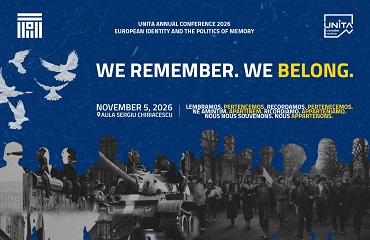
EUROPEAN IDENTITY, POLITICS OF MEMORY, AND ENGAGING EUROPE'S TOTALITARIAN PAST
5 November 2026 | 08:30–17:00,“Sergiu T. Chiriacescu” Conference Centre, Transilvania University of Brașov
The question of European identity has become especially relevant in a context marked by geopolitical tensions, democratic backsliding, the resurgence of extremist ideologies, and the challenges posed by digital transformation. Far from being a fixed or self-evident construct, European identity is continuously negotiated through collective memory, educational practices, cultural narratives, and civic engagement. In particular, the ways in which Europe’s totalitarian past is communicated to younger generations play a significant role in shaping democratic values, critical thinking, and a shared sense of belonging to European values. This thematic section invites contributions that explore the formation and transmission of European identity through the lens of historical awareness and memory politics. It seeks to examine how educational systems, cultural institutions, and public discourse contribute to fostering or fragmenting a common European civic culture. Special attention is given to the challenges of engaging younger generations in meaningful reflection on authoritarianism, propaganda, and the ethical responsibilities of citizenship in contemporary Europe. The section encourages interdisciplinary approaches that bridge sociology, media studies, political science, cultural heritage, and related fields. Key questions guiding this section include: (1) How is European identity constructed, negotiated, and contested across different national and cultural contexts? (2) How can comparative perspectives between Eastern and Western European experiences enhance a shared understanding of Europe’s past? (3) What role do memory institutions and civil society organizations play in shaping historical awareness and civic values? (4) How do digital media and new communication technologies influence the transmission of historical knowledge and collective memory? (5) In what ways can education about Europe’s difficult past contribute to strengthening democratic resilience and active citizenship among young people? By bringing together theoretical reflections, empirical research, and case-based insights, this section aims to contribute to a deeper understanding of how European identity is formed and reconfigured in times of social and digital transformation.
Submission
Abstracts should be submitted through the ACUM 2026 Conference submission platform by selecting:
Panel 17 – Extraordinary Panel on European Identity, Politics of Memory, and Engaging Europe's Totalitarian Past
Submission platform: https://acum.unitbv.ro/call-for-papers/panels
Important dates:
Abstract submission deadline: 1 September 2026
Notification of acceptance: 1–15 September 2026
Participants from UNITA Alliance universities whose papers are accepted for Panel 17 – Extraordinary Panel on European Identity, Politics of Memory, and Engaging Europe's Totalitarian Past will be exempt from the ACUM 2026 conference participation fee.