


UNITA RECIPES for Internationalisation Staff Week
24–26 February 2026
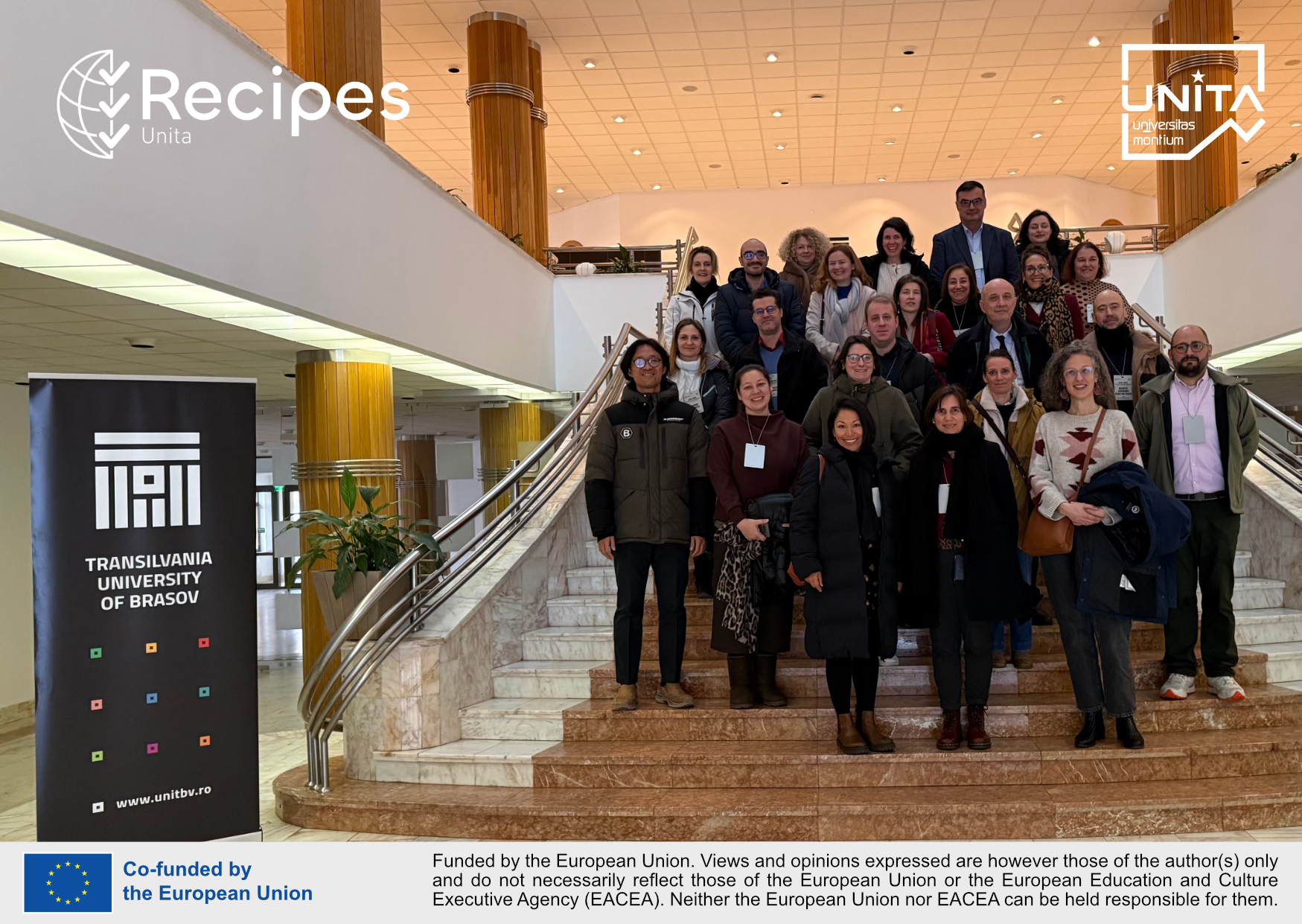
In a vibrant effort to advance internationalisation in higher education, partners of the UNITA RECIPES for Internationalisation project convened in Brasov - Romania, from 24 to 26 of February, for an intensive session of workshops and presentations designed to deepen understanding, share best practices, and build capacity for curriculum internationalisation within Recipes and UNITA universities, and across Europe. The event brought together participants from 7 universities - teachers, heads of programs, counsellors in internationalisation, staff involved in internationalisation- all aimed at increasing the level of internationalisation of their study degree program, faculty or university.
Funded by the European Union under the Erasmus+ framework and supported by Movetia for the Swiss cooperation, the UNITA RECIPES initiative brings together a broad consortium of universities and expert partners with the shared goal of fostering internationalisation and embedding global perspectives into degree programmes. Full partners include Université Savoie Mont Blanc (USMB, France) as the coordinating institution, Universidad Pública de Navarra (UPNA, Spain), Universitatea Transilvania din Brașov (UNITBV, Romania), Università degli Studi di Brescia (UNIBS, Italy), and Instituto Politécnico da Guarda (IPG, Portugal), alongside Haute Ecole Spécialisée de Suisse occidentale (HES-SO, Switzerland) and Université de Pau et des Pays de l'Adour (UPPA, France).
The heart of the project is the UNITA Recipes Handbook for Internationalisation - a practical guide offering structured “recipes” that heads of programmes and academic staff can use to design and enhance international learning experiences - and the Self Evaluation Tool - designed as an instrument to self asses the level of internationalisation of study degree programs and based on several criteria carefully selected. These tools not only address mobility and partnerships but also promote internationalisation “at home”, highlighting strategies that integrate intercultural competencies into curricula, promote virtual and hybrid programmes, as well as alternative methodologies to develop intercultural and international skills from your home campus, through curricula adaptation, international students, etc. One of the objectives is to promote inclusive internationalization “for all.”
A highlight of the recent gathering was a series of dynamic workshops led by academic researcher and educator expert Dr Sandra McGury. With a strong academic background in language education and global competence development, Sandra brought her extensive experience in pedagogical research and training to the sessions. Participants engaged with innovative methodologies for fostering global competencies within university programmes — blending practical techniques and peer-to-peer exchanges with forward-looking pedagogical insights. Her work draws on both research and hands-on international teaching collaborations, offering participants concrete tools to implement more inclusive and internationally oriented learning environments.
In addition to Sandra’s workshops, the Staff week benefitted from impactful presentations by Adrian Georgescu, Director of the National Agency for Community Programmes in the Field of Education and Vocational Training (ANPCDEFP) — Romania’s National Erasmus+ Agency — and Nicoleta Popa, Coordinator at the same agency. Their contributions underscored the strategic importance of internationalisation within the broader European education policy landscape, situating UNITA RECIPES within the context of Erasmus+ objectives and national priorities for enhancing cross-border educational cooperation. They highlighted how initiatives like UNITA’s support institutional capacity building while connecting universities to a wider ecosystem of Erasmus+ opportunities that foster innovation and intercultural exchange.
The event not only deepened partner collaboration but also reinforced shared commitments to equip academic leaders with the confidence and tools to internationalise curricula in meaningful ways. By blending institutional strategy with expert-led capacity building, the UNITA RECIPES project exemplifies how collaborative European initiatives can drive systemic change in higher education.
As the project progresses, partners anticipate further multiplier events, training modules, and dissemination activities that will extend the impact of the handbook and its associated resources — ensuring that internationalisation becomes a hallmark of degree programmes across the alliance and beyond.